Maha Padela
Product Designer
Product Design · B2B SaaS
Fleet Management & Logistics
Platform & Admin Systems
Design Systems
Hi, I’m Maha Padela, a product designer with 5+ years of experience. Currently working at Motive, I design platform-level systems that scale across the fleet management ecosystem serving hundreds of thousands of businesses. My work spans admin architecture, entity systems, configuration frameworks, and alert infrastructure — the foundational layers that other product teams build on.
I've shared work highlights below. Reach out at mahapadela25@gmail.com for a detailed walkthrough.
PLATFORM PROJECT 1/3
Enabling Remote Tachograph Downloads for UK & EU Fleets
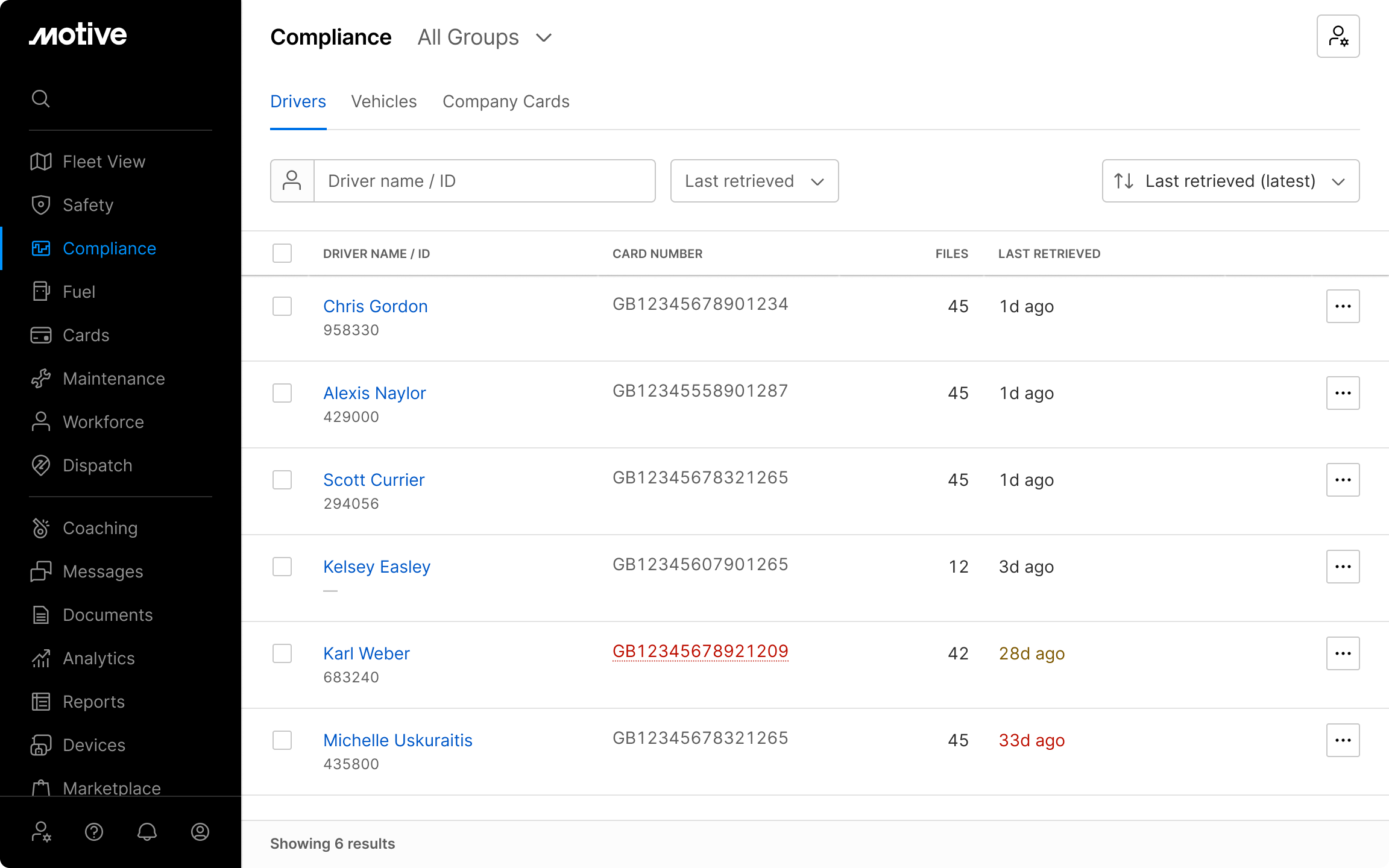
Led the expansion of Motive's platform into the UK/EU market, starting with in-depth research into European tachograph regulations and working closely with potential customers in the new markets to understand their operational needs. All designs were validated with those customers before development, and this work became central to Motive's localisation strategy and entry into the region.
For Phase 1, I designed a remote tachograph download experience built on top of Motive's existing AI-powered dashcam hardware, bringing it to par with market standards. Where European fleets had traditionally required physical access to each vehicle to pull compliance-critical data, fleet managers could now do this remotely through the Motive platform — eliminating the operational burden of manual downloads and significantly reducing compliance risk.
PLATFORM PROJECT 2/3
Rearchitecting Alert Content, Translation, and Delivery at Scale
Motive sends 10M+ alerts per month across 70+ alert types and 700+ templated communications — email, push, SMS, WhatsApp, and Notification Center — making up roughly 87% of all outbound email. Because each alert is owned by an independent product pod, content and layout had drifted significantly: critical fields were applied inconsistently, short-form messages were hard to act on, and alert designs had fallen well out of step with the product's design system. Every cross-cutting change required manual edits across hundreds of templates, and alert communications lagged the rest of the company on localization, with email almost entirely untranslated and other channels not fully supported across all languages.
This initiative tackled content quality, design system alignment, scalable translation, and platform rearchitecture in a single cross-functional push — directly supporting Motive's EU expansion, enterprise content standards, and reliability goals. My work spanned the full lifecycle: auditing all existing alerts to map use cases and gaps, developing scalable content guidelines with our content writer, testing renders across email clients, devices, and light/dark modes, and building a master CMS template covering all channels. That single source of truth means any future design or compliance change propagates across all alerts automatically — and any team adding a new alert type can do so consistently without engineering support.
PLATFORM PROJECT 3/3
Enabling Configuration at the Right Level of Granularity
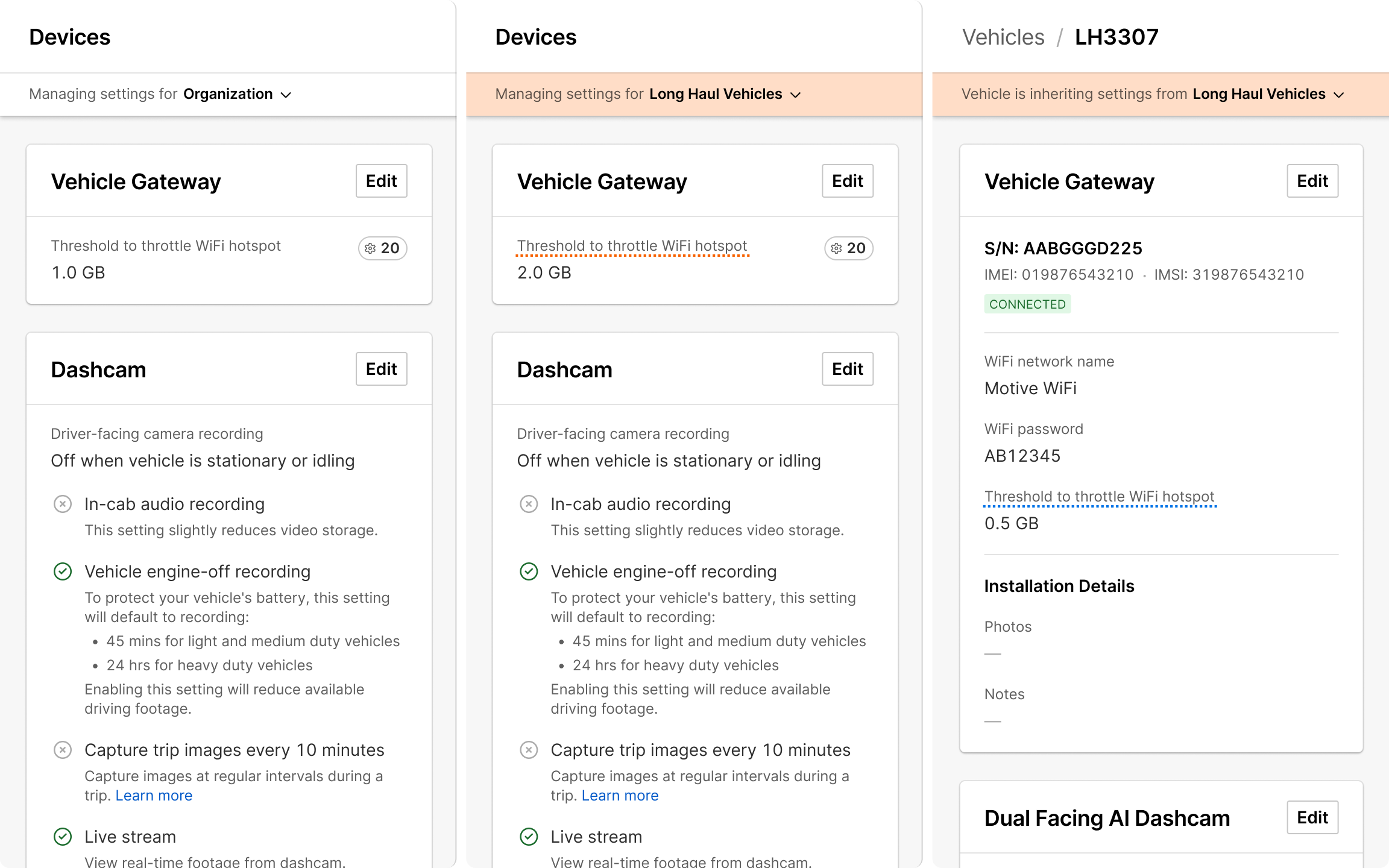
Group Level Settings introduced a hierarchical configuration model to Motive's settings architecture — built for enterprise fleets managing an average of ~253 groups, where a single org-level setting couldn't cover the variation they needed. We introduced Profiles for group-level configuration, a priority model for entities that span multiple groups, and clear UI patterns for override visibility and management. Research showed that even the largest fleets need at most 10 profiles — powerful without being over-engineered.
Designed in close collaboration with enterprise customers from early research through to validation, the patterns established here are what every team now builds on when adding settings to their product area. Entity-level overrides are live across all fleets and settings; group-level support covers safety, fuel, and device settings, with ~500 profiles created across fleets and more areas rolling out incrementally.
Group Level Settings wouldn't have been possible without the groundwork laid by Admin 2.0 — a ground-up rethink of Motive's admin panel — and the subsequent Entity Redesign, which unified how administrators create, view, and manage vehicles, drivers, assets, and fleet users. Those projects established the foundational patterns that made GLS viable. Reach out if you'd like to hear more about the Admin redesign.
Maha Padela
Product Designer
Product Design · B2B SaaS
Fleet Management & Logistics
Platform & Admin Systems
Design Systems
Hi, I’m Maha Padela, a product designer with 5+ years of experience. Currently working at Motive, I design platform-level systems that scale across the fleet management ecosystem serving hundreds of thousands of businesses. My work spans admin architecture, entity systems, configuration frameworks, and alert infrastructure — the foundational layers that other product teams build on.
I've shared work highlights below. Reach out at mahapadela25@gmail.com for a detailed walkthrough.
PLATFORM PROJECT 1/3
Enabling Remote Tachograph Downloads for UK & EU Fleets
Led the expansion of Motive's platform into the UK/EU market, starting with in-depth research into European tachograph regulations and working closely with potential customers in the new markets to understand their operational needs. All designs were validated with those customers before development, and this work became central to Motive's localisation strategy and entry into the region.
For Phase 1, I designed a remote tachograph download experience built on top of Motive's existing AI-powered dashcam hardware, bringing it to par with market standards. Where European fleets had traditionally required physical access to each vehicle to pull compliance-critical data, fleet managers could now do this remotely through the Motive platform — eliminating the operational burden of manual downloads and significantly reducing compliance risk.
PLATFORM PROJECT 2/3
Rearchitecting Alert Content, Translation, and Delivery at Scale
Motive sends 10M+ alerts per month across 70+ alert types and 700+ templated communications — email, push, SMS, WhatsApp, and Notification Center — making up roughly 87% of all outbound email. Because each alert is owned by an independent product pod, content and layout had drifted significantly: critical fields were applied inconsistently, short-form messages were hard to act on, and alert designs had fallen well out of step with the product's design system. Every cross-cutting change required manual edits across hundreds of templates, and alert communications lagged the rest of the company on localization, with email almost entirely untranslated and other channels not fully supported across all languages.
This initiative tackled content quality, design system alignment, scalable translation, and platform rearchitecture in a single cross-functional push — directly supporting Motive's EU expansion, enterprise content standards, and reliability goals. My work spanned the full lifecycle: auditing all existing alerts to map use cases and gaps, developing scalable content guidelines with our content writer, testing renders across email clients, devices, and light/dark modes, and building a master CMS template covering all channels. That single source of truth means any future design or compliance change propagates across all alerts automatically — and any team adding a new alert type can do so consistently without engineering support.
PLATFORM PROJECT 3/3
Enabling Configuration at the Right Level of Granularity
Group Level Settings introduced a hierarchical configuration model to Motive's settings architecture — built for enterprise fleets managing an average of ~253 groups, where a single org-level setting couldn't cover the variation they needed. We introduced Profiles for group-level configuration, a priority model for entities that span multiple groups, and clear UI patterns for override visibility and management. Research showed that even the largest fleets need at most 10 profiles — powerful without being over-engineered.
Designed in close collaboration with enterprise customers from early research through to validation, the patterns established here are what every team now builds on when adding settings to their product area. Entity-level overrides are live across all fleets and settings; group-level support covers safety, fuel, and device settings, with ~500 profiles created across fleets and more areas rolling out incrementally.
Group Level Settings wouldn't have been possible without the groundwork laid by Admin 2.0 — a ground-up rethink of Motive's admin panel — and the subsequent Entity Redesign, which unified how administrators create, view, and manage vehicles, drivers, assets, and fleet users. Those projects established the foundational patterns that made GLS viable. Reach out if you'd like to hear more about the Admin redesign.
Maha Padela
Product Designer
Product Design · B2B SaaS
Fleet Management & Logistics
Platform & Admin Systems
Design Systems
Hi, I’m Maha Padela, a product designer with 5+ years of experience. Currently working at Motive, I design platform-level systems that scale across the fleet management ecosystem serving hundreds of thousands of businesses. My work spans admin architecture, entity systems, configuration frameworks, and alert infrastructure — the foundational layers that other product teams build on.
I've shared work highlights below. Reach out at mahapadela25@gmail.com for a detailed walkthrough.
PLATFORM PROJECT 1/3
Enabling Remote Tachograph Downloads for UK & EU Fleets
Led the expansion of Motive's platform into the UK/EU market, starting with in-depth research into European tachograph regulations and working closely with potential customers in the new markets to understand their operational needs. All designs were validated with those customers before development, and this work became central to Motive's localisation strategy and entry into the region.
For Phase 1, I designed a remote tachograph download experience built on top of Motive's existing AI-powered dashcam hardware, bringing it to par with market standards. Where European fleets had traditionally required physical access to each vehicle to pull compliance-critical data, fleet managers could now do this remotely through the Motive platform — eliminating the operational burden of manual downloads and significantly reducing compliance risk.
PLATFORM PROJECT 2/3
Rearchitecting Alert Content, Translation, and Delivery at Scale
Motive sends 10M+ alerts per month across 70+ alert types and 700+ templated communications — email, push, SMS, WhatsApp, and Notification Center — making up roughly 87% of all outbound email. Because each alert is owned by an independent product pod, content and layout had drifted significantly: critical fields were applied inconsistently, short-form messages were hard to act on, and alert designs had fallen well out of step with the product's design system. Every cross-cutting change required manual edits across hundreds of templates, and alert communications lagged the rest of the company on localization, with email almost entirely untranslated and other channels not fully supported across all languages.
This initiative tackled content quality, design system alignment, scalable translation, and platform rearchitecture in a single cross-functional push — directly supporting Motive's EU expansion, enterprise content standards, and reliability goals. My work spanned the full lifecycle: auditing all existing alerts to map use cases and gaps, developing scalable content guidelines with our content writer, testing renders across email clients, devices, and light/dark modes, and building a master CMS template covering all channels. That single source of truth means any future design or compliance change propagates across all alerts automatically — and any team adding a new alert type can do so consistently without engineering support.
PLATFORM PROJECT 3/3
Enabling Configuration at the Right Level of Granularity
Group Level Settings introduced a hierarchical configuration model to Motive's settings architecture — built for enterprise fleets managing an average of ~253 groups, where a single org-level setting couldn't cover the variation they needed. We introduced Profiles for group-level configuration, a priority model for entities that span multiple groups, and clear UI patterns for override visibility and management. Research showed that even the largest fleets need at most 10 profiles — powerful without being over-engineered.
Designed in close collaboration with enterprise customers from early research through to validation, the patterns established here are what every team now builds on when adding settings to their product area. Entity-level overrides are live across all fleets and settings; group-level support covers safety, fuel, and device settings, with ~500 profiles created across fleets and more areas rolling out incrementally.
Group Level Settings wouldn't have been possible without the groundwork laid by Admin 2.0 — a ground-up rethink of Motive's admin panel — and the subsequent Entity Redesign, which unified how administrators create, view, and manage vehicles, drivers, assets, and fleet users. Those projects established the foundational patterns that made GLS viable. Reach out if you'd like to hear more about the Admin redesign.